Recruitment Process Outsourcing Service Level Agreements: A Complete Guide for Indian Businesses
In today's competitive hiring landscape, organizations across India are increasingly turning to Recruitment Process Outsourcing (RPO) providers to streamline talent acquisition and improve hiring outcomes. However, the success of any RPO partnership largely depends on clearly defined expectations, measurable outcomes, and accountability frameworks. This is where Service Level Agreements in Recruitment Process Outsourcing become essential.
A well-structured SLA serves as the foundation of a successful RPO engagement. It outlines responsibilities, performance metrics, timelines, communication protocols, and quality standards that both the client organization and the RPO provider must follow.
As India's talent market continues to evolve, businesses need recruitment partnerships that deliver consistent results while maintaining transparency. A strong SLA for RPO Services helps ensure both parties remain aligned toward common hiring goals.
What is a Service Level Agreement in Recruitment Process Outsourcing?
A Service Level Agreement (SLA) is a formal agreement that defines the expected level of service between an organization and its RPO provider.
In recruitment outsourcing, the SLA establishes measurable standards for:
- Candidate sourcing
- Screening processes
- Interview coordination
- Hiring timelines
- Reporting frequency
- Candidate quality
- Compliance requirements
- Communication expectations
An effective HR SLA in Recruitment Process Outsourcing (RPO) acts as a roadmap that guides the entire recruitment engagement while minimizing misunderstandings and performance gaps.
Why Service Level Agreements Matter in RPO
Many organizations assume recruitment success depends solely on filling vacancies. However, modern recruitment involves multiple performance indicators that impact business growth.
Service level agreements provide:
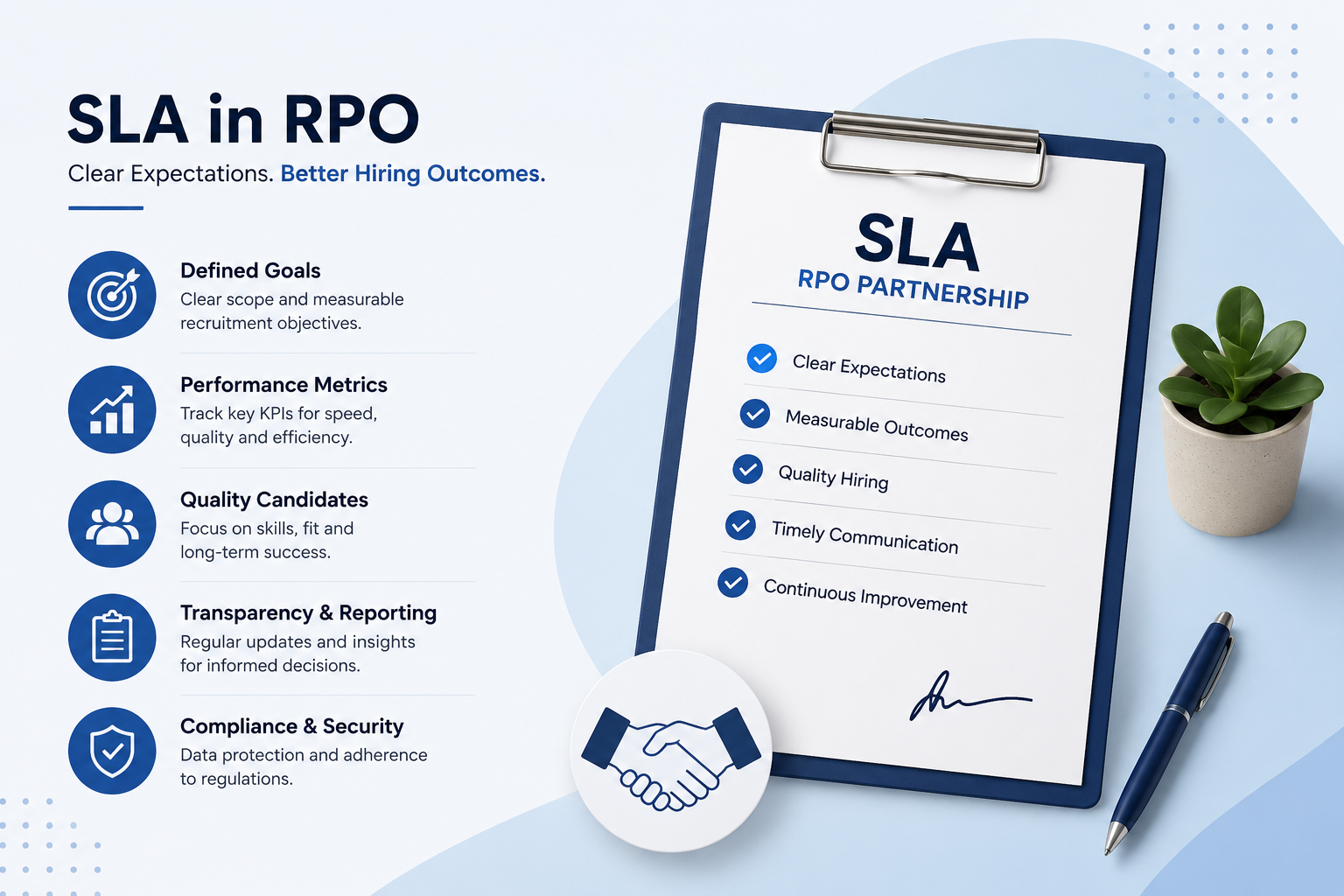
- Clear Expectations - Both parties understand their responsibilities from day one.
- Improved Accountability - Performance can be measured objectively using predefined KPIs.
- Better Hiring Outcomes - Clearly defined recruitment standards help improve candidate quality.
- Enhanced Transparency - Regular reporting ensures visibility into recruitment progress.
- Stronger Business Relationships - SLAs reduce conflicts by establishing mutually agreed standards.
- Continuous Improvement - Data-driven reviews allow organizations to optimize hiring strategies over time.
Key Components of an Effective SLA for RPO Services
1. Scope of Services
The agreement should clearly define recruitment activities covered by the RPO provider.
Examples include:
- Talent sourcing
- Candidate screening
- Assessment management
- Interview scheduling
- Offer management
- Employer branding support
- Recruitment analytics
Defining scope prevents misunderstandings and scope creep.
2. Recruitment Performance Metrics
Performance metrics are the backbone of every SLA.
Common recruitment KPIs include:
- Time-to-Fill - Measures the number of days required to fill a position.
- Time-to-Submit - Tracks how quickly qualified candidates are presented.
- Interview-to-Hire Ratio - Evaluates recruitment efficiency.
- Offer Acceptance Rate - Measures candidate engagement and employer attractiveness.
- Candidate Retention Rate - Assesses long-term hiring quality.
- Hiring Manager Satisfaction - Reflects internal stakeholder satisfaction levels.
3. Candidate Quality Standards
Quality should never be sacrificed for speed.
The SLA should define:
- Required qualifications
- Experience levels
- Skill assessments
- Cultural fit requirements
- Technical evaluation standards
Organizations that prioritize candidate quality often experience lower turnover rates and higher employee performance.
4. Communication and Reporting Standards
Regular communication is essential for successful RPO partnerships.
The SLA should specify:
- Weekly status meetings
- Monthly performance reviews
- Quarterly business reviews
- Escalation procedures
- Reporting formats
Transparency helps stakeholders make informed hiring decisions.
5. Compliance and Data Security Requirements
Indian organizations must comply with various employment and data protection regulations.
The SLA should address:
- Candidate data handling
- Privacy requirements
- Record retention policies
- Diversity hiring compliance
- Background verification standards
Compliance reduces legal risks while protecting employer reputation.
Essential Recruitment KPIs Included in HR SLA in Recruitment Process Outsourcing (RPO)
- Time-to-Fill
- Benchmark:
- Entry-level positions: 20–35 days
- Mid-level roles: 30–45 days
- Senior leadership positions: 60–90 days
- Candidate Submission Rate
- Measures sourcing efficiency and recruiter productivity.
- Candidate Quality Score
- Based on:
- Interview feedback
- Assessment results
- Hiring manager ratings
- Offer Acceptance Rate
- Strong RPO providers typically maintain high offer acceptance percentages through effective candidate engagement.
- First-Year Retention Rate
- A valuable indicator of long-term recruitment success.
- Hiring Manager Satisfaction Score
- Usually measured through post-hire surveys.
Candidate Experience Metrics That Modern RPO SLAs Should Include
Many organizations focus solely on hiring outcomes while ignoring candidate experience.
Modern SLAs should track:
- Candidate Response Time - How quickly recruiters respond to applications.
- Interview Scheduling Speed - Efficiency in coordinating interviews.
- Candidate Satisfaction Scores - Feedback gathered throughout the hiring journey.
- Communication Consistency - Regular updates during recruitment stages.
Positive candidate experiences improve employer branding and attract top talent.
Industry-Specific SLA Considerations in India
Different industries require unique recruitment standards.
IT and Technology
Focus on:
- Technical screening accuracy
- Niche talent sourcing
- Remote hiring capabilities
- Skills validation
Manufacturing
Prioritize:
- Workforce scalability
- Compliance requirements
- Shift-based recruitment
Healthcare
Require:
- Credential verification
- Licensing compliance
- Critical role turnaround times
BFSI
Emphasize:
- Background checks
- Regulatory compliance
- Security screening
Common Challenges in Managing Service Level Agreements in Recruitment Process Outsourcing
- Unclear Expectations: Vague objectives often lead to disputes.
- Unrealistic Hiring Timelines: Aggressive targets may impact candidate quality.
- Poor Communication: Lack of regular updates can create frustration.
- Inadequate Reporting: Insufficient data limits decision-making capabilities.
- Changing Business Requirements: Organizations frequently adjust hiring needs.
Effective SLA governance helps overcome these challenges.
Best Practices for Creating a Successful SLA for RPO Services
- Align Recruitment Goals with Business Objectives
- Recruitment KPIs should directly support organizational growth strategies.
- Define Measurable Metrics
- Avoid subjective performance indicators whenever possible.
- Establish Review Cycles
- Regular evaluations help identify improvement opportunities.
- Include Escalation Procedures
- Clear escalation paths prevent minor issues from becoming major problems.
- Encourage Collaboration
- Successful RPO partnerships require active participation from both parties.
Technology's Role in Modern HR SLA in Recruitment Process Outsourcing (RPO)
Technology has transformed recruitment outsourcing significantly.
Modern RPO providers leverage:
- Applicant Tracking Systems (ATS)
- Improve workflow management and reporting accuracy.
- Artificial Intelligence
- Enhances sourcing efficiency and candidate matching.
- Recruitment Analytics
- Provides real-time performance insights.
- Automation Tools
- Reduce administrative workloads and accelerate hiring processes.
Technology-driven SLAs can include metrics related to automation efficiency, candidate engagement, and reporting accuracy.
How to Measure SLA Success
Organizations should regularly evaluate:
- Hiring speed
- Candidate quality
- Cost-per-hire
- Retention rates
- Stakeholder satisfaction
- Diversity hiring outcomes
- Recruitment scalability
Continuous monitoring ensures long-term recruitment success.
Future Trends in Service Level Agreements in Recruitment Process Outsourcing
The recruitment industry continues to evolve rapidly.
Emerging SLA trends include:
- AI Performance Metrics
- Tracking AI-assisted sourcing effectiveness.
- Skills-Based Hiring Metrics
- Evaluating candidates based on capabilities rather than traditional qualifications.
- Diversity and Inclusion Benchmarks
- Measuring workforce diversity outcomes.
- Predictive Recruitment Analytics
- Using data to forecast hiring needs.
- Employee Experience Metrics
- Extending recruitment measurements beyond hiring.
Organizations adopting these innovations can gain a competitive talent advantage.
Choosing the Right RPO Partner
Before signing any agreement, organizations should evaluate:
- Industry expertise
- Recruitment technology capabilities
- Performance history
- Scalability
- Compliance knowledge
- Reporting capabilities
- Candidate experience approach
A well-qualified RPO partner should demonstrate a proven ability to meet agreed SLA standards consistently.
Conclusion
A well-designed Service Level Agreements in Recruitment Process Outsourcing framework serves as the foundation for successful talent acquisition partnerships. By clearly defining expectations, performance metrics, communication standards, and accountability measures, organizations can significantly improve recruitment outcomes while maintaining transparency and control.
As India's recruitment landscape becomes increasingly competitive, businesses must move beyond basic hiring metrics and adopt comprehensive SLA frameworks that prioritize candidate quality, stakeholder satisfaction, compliance, and long-term workforce success. A strategic SLA for RPO Services not only improves recruitment efficiency but also strengthens the partnership between organizations and their outsourcing providers.
Investing in a robust HR SLA in Recruitment Process Outsourcing (RPO) ultimately helps organizations build stronger teams, reduce hiring risks, and achieve sustainable business growth.
Frequently Asked Questions (FAQs)
- What are Service Level Agreements in Recruitment Process Outsourcing?
They are formal agreements that define recruitment performance standards, responsibilities, timelines, and measurable outcomes between an organization and an RPO provider. - Why is an SLA important for RPO services?
An SLA establishes accountability, improves transparency, defines expectations, and helps ensure recruitment goals are consistently achieved. - What KPIs should be included in an SLA for RPO Services?
Common KPIs include time-to-fill, candidate quality, offer acceptance rate, retention rate, hiring manager satisfaction, and candidate experience metrics. - How often should RPO SLA performance be reviewed?
Most organizations conduct monthly operational reviews and quarterly strategic business reviews. - Can SLA metrics improve hiring quality?
Yes. Clearly defined quality benchmarks encourage recruiters to focus on finding suitable candidates rather than simply filling vacancies quickly. - What is the difference between an HR SLA and an RPO SLA?
An HR SLA generally covers broader HR services, while an RPO SLA specifically focuses on recruitment-related processes, metrics, and outcomes. - How do Indian businesses benefit from RPO service level agreements?
They gain improved hiring efficiency, better talent quality, reduced recruitment costs, enhanced compliance, and stronger workforce planning capabilities.
A well-structured SLA in Recruitment Process Outsourcing (RPO) helps organizations improve hiring efficiency, accountability, and candidate quality. By defining clear performance metrics, communication standards, and compliance requirements, businesses can achieve better recruitment outcomes. Investing in the right RPO partner and SLA framework supports long-term workforce growth and hiring success.
Related Post
Headhunting is a proactive recruitment strategy used to identify and attract highly skilled professi...
In today's fast-evolving talent landscape, recruitment is no longer just about filling vacancies—it'...




 Chat with us